Anaerobic respiration

Anaerobic respiration: O is slower than aerobic respiration produces two ATP molecules for each molecule of glucose metabolized only occurs when oxygen is present does not produce toxic (fatigue producing) products a and d QUESTION 43 The sarcolemma is: the cell membrane of the muscle fiber epimysium covering the muscle the endoplasmic reticulum of muscle site of ATP production none of the above h QUESTION 44 The latent period of a muscle: O occurs during the time of contraction and relaxation O occurs during the time of relaxation and contraction O is of no longer duration than the contraction period O occurs from the moment of stimulation until the muscle shortens O is longer than the contraction phase 4 QUESTION 32 Cori cycle describes the recycling of glucose? O True O False 12 QUESTION 33 Which of the following statements concerning the actin myofilament is false? one of its components is tropomyosin the myofilament is a double helix it contains G-actin O it contains troponin O both actin and myosin form part of the actin myofilament
Which of the following anatomical functions are performed by the muscles of the lateral compartment of the lower leg at the talocrural and subtalar joints?

Which of the following anatomical functions are performed by the muscles of the lateral compartment of the lower leg at the talocrural and subtalar joints? (Read this question carefully, and be sure to identify all correct answers)

dorsiflexion

plantar flexion

inversion

eversion

What muscle attaches from the posterior surfaces of the condyles of the femur TO the calcaneus via the calcaneal tendon?

What muscle attaches from the posterior surfaces of the condyles of the femur TO the calcaneus via the calcaneal tendon? O soleus gastrocnemius popliteus tibialis posterior plantaris

What does dehydration have to do with diabetes?

What does dehydration have to do with diabetes? What happens if you do not treat Type 1 diabetes? What happens if you do not treat Type 2 diabetes?

Identify the spinal nerves and plexuses

Identify the spinal nerves and plexuses (A-K). Each letter will only be used once. 17. Lumbo-sacral plexus_ 23. Brachial plexus 18. Cervical nerves 24. Thoracic nerves 19. Cauda equina 25. Lumbar plexus 20. Lumbar nerves 26. Sacral nerves 21. Coccygeal nerves 27. Cervical plexus_ 22. Sacral plexus_

Listed below are some of the substances that the kidney filters and then reabsorbs

Listed below are some of the substances that the kidney filters and then reabsorbs. For each part of the nephron, categorize the substances that are reabsorbed or not reabsorbed by that region. Proximal tubule Amino acids Chloride Glucose Sodium Water Collecting duct In the presence of ADH. Amino acids Reabsorbed Reabsorbed 1.5 pts Not reabsorbed 1.5 pts Not reabsorbed Collecting duct In the presence of ADH. Amino acids Chloride Glucose Sodium Water Reabsorbed 1.5 pts Not reabsorbed

Describe a disease or condition of the integumentary system

find and describe a disease or condition of the integumentary system that you find interesting. See if you can find one that is less common or one you haven’t heard of before, so we can all learn something new! Possible things to include might be causes, symptoms, treatments, who tends to be affected, etc. Be sure to include some anatomy and physiology in your description. 200-word maximum.

Which of the following concerning peripheral vasoconstriction (PV) during the diving reflex, when carrying out facial immersion with a snorkel is correct?

Which of the following concerning peripheral vasoconstriction (PV) during the diving reflex, when carrying out facial immersion with a snorkel is correct? An Apnea and inhibition of the respiratory muscles play a fundamental role B) PV is dependent on the vagal control of blood vessels A pontine neuronal network in the brain activates the sympathetic nervous system to induce PV Sensory information relayed via the NTS activates cells in the IML of the spinal cord which in turn promotes sympathetically induced PV. Activation of the NTS neurons projecting to the nucleus ambiguous is essential for Section 4: Reflex Physiology (Questions 13-20) Question 13 Which afferent and efferent neurons are principally involved in the stretch reflex? A Group la afferents and gamma motoneurones B Group Ib afferents and alpha motoneurones Group la afferents and alpha motoneurones D Group II and gamma motoneurones Group II and alpha motoneurones Question 14 The stretch reflex is characterised as being an? Excitatory disynaptic reflex B) Inhibitory monosynaptic reflex 2 Points Inhibitory disynaptic reflex D Excitatory monosynaptic reflex Excitatory polyphasic reflex 2 Points 2 Points

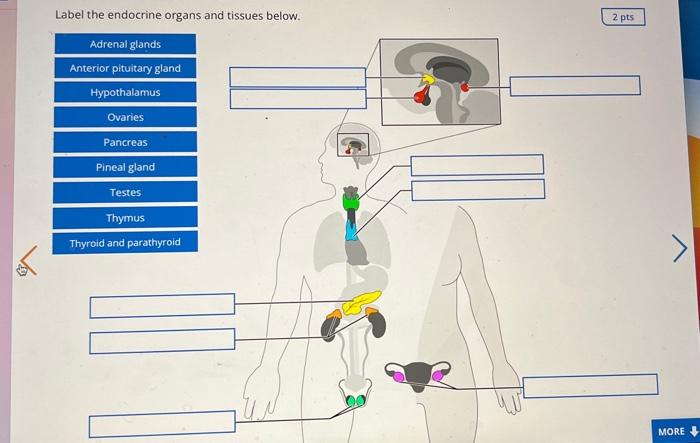
Label the endocrine organs and tissues below.

Label the endocrine organs and tissues below. Adrenal glands Anterior pituitary gland Hypothalamus Ovaries Pancreas Pineal gland Testes Thymus Thyroid and parathyroid C. 2 pts Label the endocrine organs and tissues below. Adrenal glands Anterior pituitary gland Hypothalamus Ovaries Pancreas Pineal gland Testes Thymus Thyroid and parathyroid 2 pts MORE

Label the endocrine organs and tissues below. Adrenal glands Anterior pituitary gland Hypothalamus Ovaries Pancreas Pineal gl

Pyelonephritis disease

Darla Moore is a 54-year-old African American woman. She is hospitalized for pyelonephritis disease. The physician orders ciprofloxacin (Cipro) 400 mg every 12 hours for 2 days and then Cipro 500 mg by mouth every 12 hours for 12 more days. (Learning Objectives 2, 4)

1. What pre-administration assessments should be completed before starting Mrs. Moore on Cipro?

2. Cipro is available in a 10-mg/mL vial. How many milliliters will the nurse need to prepare for one 400-mg dose?

3. What should the nurse tell Mrs. Moore about the Cipro before she leaves the hospital?