Which of the following will cause an increased risk of thrombosis?

Which of the following will cause an increased risk of thrombosis? Select one: O a. Reduction in the amount of antithrombin III in . the circulation. O b. An increase in the amount of plasmin in the circulation i O c. Nitric oxide production by endothelial cells O d. Prostaglandin PGI2 production by endothelial cells. e. High levels of fibrin degradation products in the circulation.
What are the four statistical approaches for phylogenetic reconstruction we discussed in class?

What are the four statistical approaches for phylogenetic reconstruction we discussed in class? Which of them attempt to recapitulate actual evolutionary events? Which would you use to determine the phylogeny of 35 species of rotifer? Please Explain why!

The four statistical approaches for phylogenetic reconstructions are “Distance, Maximum Parsimony, Maximum Likelihood & Bayesian”

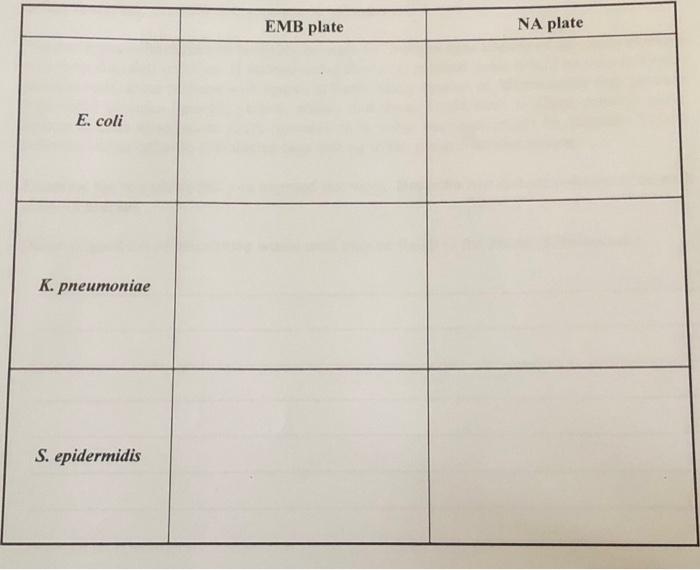
The cultural characteristics of each of the bacteria

Give a brief description of the cultural characteristics of each of the bacteria on the two different media used ( EMB plate and NA plate)
EMB plate NA plate E. coli K. pneumoniae S. epidermidis

Discuss why the battery of initial plates must include one nutritive

Discuss why the battery of initial plates must include one nutritive or general plate and in addition any selective and/or differential plates that may be useful. S5.3 For each of the media listed in section 5 introduction, name the media (name, not just initial) and describe 1) what it is used for 2) why it is useful. ROI


 Describe the general steps for identification of clinical species by culture

Describe the general steps for identification of clinical species by culture, including the practice of direct smear, a battery of initial plates, followed by biochemical testing of potential pathogens, and antimicrobic susceptibility tests. Include the purpose of each step

Biotechnology applications

In various biotechnology applications, double-stranded DNA is often denatured (separated) into single strands by heating to near-boiling temperatures. Looking at the two types of base pairs (Figure 3.9 in your book), would A-T-rich sequences or G-C-rich sequences denature more readily?

Proteins whose concentration increases dramatically during inflammation are called

Proteins whose concentration increases dramatically during inflammation are called

    1. Interferons
    2. Acute-phase proteins
    3. Opsonins
    4. Phagocytes

Explain why you may not want to reduce a fever

Explain why you may not want to reduce a fever. In a physiological sense, what good is it? A co-worker recently got shingles, a neurological disease caused by the chicken pox virus. The co-worker was surprised to receive a prescription for an antiviral medicine because he thought there was nothing one could do about viral infection. If the medication is similar to natural interferons, what are two things that you can tell your co-worker about what the medicine might do?

Which of the following statements about cells involved in acute inflammation is FALSE?

Which of the following statements about cells involved in acute inflammation is FALSE? Select one: a. Mast cells contain prominent cytoplasmic granules and are found at mucosal surfaces O b. Neutrophils contain cytoplasmic granules and phagocytose bacteria. O c. Macrophages have a larger, pale, oval nucleus with abundant cytoplasm O d. Lymphocytes have a round, dense, nucleus with scant cytoplasm O e. Eosinophils have a regular-shaped nucleus and lack cytoplasmic granules

Which of the following will NOT predispose to thrombosis?

Which of the following will NOT predispose to thrombosis? Select one: O a. Sluggish blood flow within the venous system due to prolonged immobility O b. Loss of antithrombin III through diseased glomeruli O c. Turbulent blood flow across damaged endocardium O d. Production of IL-6 by activated macrophages O e. Endothelial damage from a viral infection