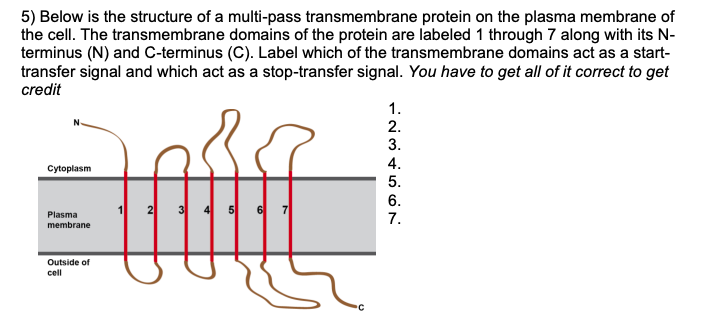
The structure of a multi-pass transmembrane protein on the plasma membrane of the cell

Below is the structure of a multi-pass transmembrane protein on the plasma membrane of the cell. The transmembrane domains of the protein are labeled 1 through 7 along with its N- terminus (N) and C-terminus (C). Label which of the transmembrane domains act as a start-transfer signal and which act as a stop-transfer signal. You have to get all of it correct to get credit Cytoplasm Plasma membrane Outside of cell


5) Below is the structure of a multi-pass transmembrane protein on the plasma membrane of the cell. The transmembrane domains

Discuss the relevance of sensory transduction pathways

Discuss the relevance of sensory transduction pathways in the context of any one of the five major senses.

Research the Centers for Medicare and Medicaid Services

Research the Centers for Medicare and Medicaid Services (CMS).

  1. What is their organizational structure?
  2. What is their mission?
  3. What is their vision?

In the case of the integumentary system the tissues are epithelial

In the case of the integumentary system the tissues are epithelial, muscle, nervous and connective. What are the organs that these tissues form that result in an organ system?

A triple-point testcross of a plant is used to determine the order of linked genes

A triple-point testcross of a plant is used to determine the order of linked genes g, t, and l. The wild-type parental phenotypes are green, tall, and leafy, represented by the triple heterozygote g+t+l+/gtl. The mutant plants are red, dwarf, and sparse, represented by the triple recessive genotype gtl/gtl. The least frequent phenotypes in the progeny of the testcross are red, tall, and leafy, and green, dwarf, and sparse. Based on the results of the testcross below, what is the genetic distance in map units between the genes g and l?
t+g+l+ 72
tgl 69
t+gl 21
tg+l+ 18
t+gl+ 9
tg+l 8
t+g+l 2
tgl+ 1
Total 200


A. 5

B. 8

C. 10

D. 2

The adaptive immune response includes immune cells’ memories of past pathogens

The adaptive immune response includes immune cells’ memories of past pathogens. In the future, those immune cells will be better able to respond to a multitude of different pathogens because their “memory” is highly mutagenic. (T/F)
why is this false?

Which of the following is a correctly labeled image of an earthworm’s musculoskeletal system

Which of the following is a correctly labeled image of an earthworm’s musculoskeletal system in cross-section? circular muscle cuticle peritoneum a. longitudinal muscle peritoneum long lauding muscle cuticle
Circular b. epidermis – cuticle epidermis circular muscle longitudinal muscle

35972225-3556529.jpeg

Explain the process of conducting a monohybrid cross for a single trait?

Explain the process of conducting a monohybrid cross for a single trait?  Please write it in two hundred word

Describe five functions of the skeletal system

Describe five functions of the skeletal system. 2. How many bones does the adult skeleton typically contain? 3. What are the six categories used to classify bones based on their shapes? (Provide an example for each category.) 4. Define the following bone markings: Canal Head Spine Condyle Line Sulcus Crest Meatus Trochanter Facet Neck I Trochlea Fissure Process Tubercle Foramen Ramus Tuberosity Fossa Sinus 5. Describe each of the following regions/structures of a long bone. Diaphysis Epiphysis

What is the prevalence of toxoplasmosis?

What is the prevalence of toxoplasmosis? 6. The prevalence of toxoplasmosis of is common because it can be foodborne, mother to child, and animal to human. . How is toxoplasmosis typically diagnosed? What challenges are associated with interpreting test results? How can fetal infection be determined? 7. Toxoplasmosis is typically diagnosed by serologic testing that is a test that measures immunoglobulin G and used to determine if a person is infected. Diagnosis can also be made by direct observation of the parasite but staining tissue. Challenges that are associated with interpreting the test results are the presence of antibodies that blend in with the parasites. Fetal infection can be determined by signs and symptoms that include enlarged liver or spleen, vomiting, eye damage low birth weight. And etc. . Describe the principal treatment protocols for toxoplasmosis infection in a pregnant patient. Indicate the pros and cons of each treatment. When is the best time during the course of Toxoplasmosis infection to administer treatment to a patient? 8. When treating an infected pregnant woman, they will be given an antibiotic called spiramycin. If your unborn child has it, your doctor will use a different form of treatment but only in extreme cases. The cons of this are that it may cause serious side effects for both the mother and the baby. The pros are that the drug may reduce that baby’s risk of having neurological problems. The best time to administer treatment to a patient is when the signs and symptoms are first seen. . Explain the correlation between the gestational age of maternal seroconversion for toxoplasmosis and the risk of fetal infection.