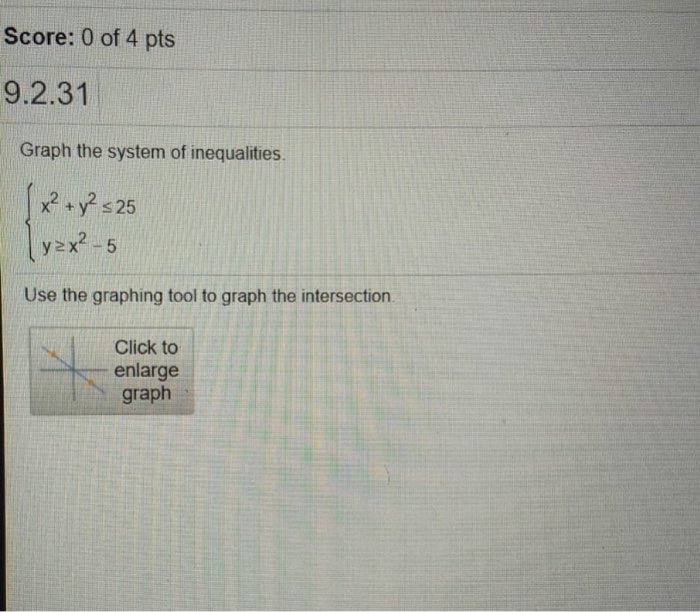
Graph the system of inequalities
Graph the system of inequalities. 2 Use the graphing tool to graph the intersection. Click to enlarge graph

Graph the system of inequalities. 2 Use the graphing tool to graph the intersection. Click to enlarge graph
1) Use summation formulae to determine the following sum (your answer will involve nn). This is complicated; carefully work it out with pencil and paper. Here nn is an unknown constant; if you are having trouble figuring out how to solve the sum, try letting n=5 and seeing how it works and then go back to using n. Note the ‘square.’
n
 (2+i/n)^2 (1/n)
i=1
The sum=
Use your work from above to determine the value of the limit of this same sum.
the lmit of the sum=
2) Fill in the table of values for the given functions on the given intervals for the right-hand Riemann sum Right (n)(n). Note that the summation in the middle of the table goes with the column that follows. For the next to last column you will have to simplify Right (n)(n) by hand on paper. In the last column take the limit.
a) f(x)= x^2-3 on interval (0,3)
f(x)= 4(x-1)^3 on interval (1,3)
For these two find deltax, (xi) right end point, (f(xi)) the height, Formula for right (n), Simplified – No Sum, and Lim n goes to infinity RIght (n)
In anti-aging and wrinkle formation where would the active ingredients in anti-aging cream need to penetrate, in terms of the epidermis, dermis, and subcutaneous tissues, and what would it need to do there?
In your own words, explain how genetic diversity in non-domesticated organisms might contribute to Agriculture and to Human Health.
Phosphofructokinase-1 (PFK-1) is a large enzyme that catalyzes the phosphorylation of fructose 6-phosphate during glycolysis. In fungi, the PFK-1 enzyme is composed of four alpha subunits and four beta subunits. How would you describe the quaternary structure of PFK-1? (2pts) A. aß heterodimer B. heterotetramer C. α4β4 homotetramer D. daf4 homooctamer E. a4ßs heterooctame
The Ras protein is an important protein in signaling processes within the cell. It exists freely in the cell cytoplasm, but must become anchored to the inner surface of the cell membrane in order to carry out its function. What kind of modification to the protein might take place to allow this to happen?
A 26-year-old woman, with a history of metabolic syndrome, hypertension, and type 2 diabetes mellitus, is visiting the health care provider’s office to discuss weight loss options. She reports that she has been overweight since she was a teenager, and that she has tried many diets but has been unsuccessful. She is upset that she has gained 10 pounds since her last visit to her HCP. The nurse documents these findings as part of today’s assessment: Height: 5 ft 5 inches; weight 314.5 lbs (143 kg). Weight last visit was 304.2 lbs (138.3 kg). BMI: 52.3. Vital signs: Blood pressure 177/98 mm Hg, pulse 88 bpm, respirations 12 breaths/min, temperature 98.2°F (36.8°C). Waist circumference: 39.8 inches; Waist-to-hip ratio: 1.0; Reflexes 3 overall; no edema noted in the ankles. Fasting lab work reveals HDL 35 mg/dL; LDL 150 mg/dL mg/dL; total cholesterol 270 mg/dL; triglycerides 173 mg/d; blood glucose 185 mg/dL; BUN 15 mg/dL; creatinine 9 mg/dL; hemoglobin 11 g/dL; hematocrit 35%. She reports that her menstrual cycles are irregular, and she has not had a normal period for 6 months. She also reports that she tries to go on walks with her husband but can’t walk very far without getting short of breath.
1. NGN Item Type: Highlighting/Enhanced Hot Spot
Highlight the assessment findings that require follow-up by the nurse.
Rationale:
Cognitive Skill: Recognize Cues
2. NGN Item Type: Cloze
Choose the most likely options for the information missing from the statement, below, by selecting from the list of options provided.
The nurse recognizes that, based on the assessment data and patient’s history, the patient is currently at risk for complications, including __________, __________, __________, _________, and __________.
Options
Cardiovascular disease
Depression
Infertility
Liver cirrhosis
Lymphoma
Lumbar disk disease
Colorectal cancer
Rationale:
Cognitive Skill: Analyze Cues
Scenario: The patient discusses her options with her health care provider, her family and
her boyfriend, and ultimately decides to have bariatric surgery. Six months later, she undergoes Roux-en-Y gastric bypass surgical procedure. After the surgery, she is admitted to the bariatric surgery unit. She has a dressing over the abdominal wound, and has intravenous fluids infusing via a PICC line. She is awake and alert and asking for something to drink. She is awake and alert and asking for something to drink. Her pain level is 4/10 on a 10-point scale.
Image transcription text
1. NGN Item Type: Extended Multiple Response
Based on the patient’s current treatment plan, the patient’s priority needs will be to prevent which of the following? Select all that apply.
_____ 1. Swallowing problems
_____ 2. Dehydration
_____ 3. Electrolyte imbalances
_____ 4. Dumping syndrome
_____ 5. Balloon deflation
_____ 6. Chronic anemia
_____ 7. Thrombus formation
_____ 8. Infection
Rationale:
Cognitive Skill: Prioritize Hypotheses
2. NGN Item Type: Extended Drag and Drop
Use an X (or drag and drop) to indicate which actions listed in the left column would be included in the plan of care for this patient.
| Nursing Actions | Relevant Nursing Actions |
| Offer fluids when the patient is fully awake and there are no signs of an anastomosis leak. | |
| Begin fluid intake at 15 mL increments every 10 to 15 minutes, gradually increasing to an intake goal of 90 mL every 30 minutes by postop day 1. | |
| Offer small drinks of fluids with ice. | |
| Offer low-sugar clear liquids. | |
| Administer low-dose heparin as ordered. | |
| Maintain bedrest until post-operative day 2. | |
| Perform active and passive range-of-motion exercises. | |
| Assess the abdominal wound frequently. | |
| Medicate for pain as needed. |
Rationale:
Cognitive Skill: Generate Solutions
Scenario: On postoperative day 5, the patient is preparing for discharge soon. She is now eating a low fat, full liquid diet, and has been able to walk down the hallways with the physical therapist several times a day. The abdominal incision is dry and intact, and she had a loose bowel movement yesterday. She is looking forward to leaving the hospital and her parents have said they will help her for a few weeks while she recovers.
1. NGN Item Type: Matrix
Use an X for nursing actions listed below that are Indicated (necessary), Contraindicated (could be harmful), or Nonessential (not necessary). Only one selection can be made for each nursing action.
| Nursing Action | Indicated | Contraindicated | Nonessential |
| Instruct the patient to transition to regular food in 2 weeks. | |||
| Teach the patient to avoid foods high in carbohydrates and calorie-dense foods. | |||
| Instruct the patient to keep skinfolds clean and dry. | |||
| Inflate the band via the subcutaneous port as needed. | |||
| Administer oral cobalamin to prevent cobalamin deficiency. | |||
| Encourage the patient to use a straw for fluid intake. |
Rationale:
Cognitive Skill: Take Action
2. NGN Item Type: Extended Multiple Response
The nurse evaluates the effectiveness of actions. Which of the following findings indicate effectiveness? Select all that apply.
_____ 1. The patient has lost weight since being admitted for surgery.
_____ 2. The patient’s abdominal incision is reddened with some gaps noted at the edges.
_____ 3. The patient takes the multivitamin supplements daily.
_____ 4. The patient states that she will go to postoperative clinic visits if she does not lose weight.
_____ 5. The patient eats 6 small meals a day.
_____ 6. The patient consumes fluids with her meals.
_____ 7. The patient states that she plans to get pregnant within 4 months.
_____ 8. The patient states that she will eat slowly and stop when she feels full.
Rationale:
Cognitive Skill: Evaluate Outcomes
72-year-old Tom Nielson has late-stage prostate cancer with secondary tumours in his lungs and brain. He is currently a resident in a retirement village where he lives in a single room.
Tom is a retired airline pilot and prior to developing cancer, was relatively healthy enjoying retirement with his wife Connie on their large lifestyle block out of town. They enjoyed being together out in the garden and spending time with their many friends in the local area. Tom was a smoker (gave up 5 years ago after smoking for 45 years), always enjoyed a few drinks on a Friday in the local pub and had also taken up golf. Connie continues to live in the family home 30 km out of town, and visits her husband as often as possible.
Tom and Connie have two daughters. Sarah aged 45, a land agent who lives 100 km away in a small town and Beatrice, aged 41, a lawyer who lives nearby. Both are very busy with their adolescent children and their careers. Tom and Connie also have a son who they no longer have any contact with, after a big argument 10 years ago. He lives in Australia.
Over the last week or two, Tom has become more confused, often forgetting where he is and who staff and family members are. He has been having episodes of agitation and tearfulness and is often reporting pain despite receiving regular pain medication. And while his appetite has been small, he has been managing a little of the small high protein meals provided by the facility.
After a visit with Tom one day, Connie reports that he is refusing to eat and drink, choosing instead to sleep. She also mentions that his breathing seems shallow and she is concerned that he feels cold to touch. She asks for a warm blanket for her husband as she thinks he may be “coming down with something”
A Postpartum woman has developed mastitis. At a previous physician appointment, it was noted that she was experiencing postpartum blues, but she assured Finesse snap out of it. However, I do follow up appointments, do not notice that symptoms of depression has progressed. Identify how did nurse should proceed and discussed the medical management of this patient. What can be done if the woman refuses to seek treatment or help?
For patients with nutritional deficits and nutritional counseling done by a registered dietician helps the patient understand which foods are safe and nutrient-dense in order to gain the most nutritional values. The overall well-being of the patient depreciates once the loss of bulk begins. Dietary counseling benefits the total well-being of the patient as it is their fuel to enable the other therapies to be successful. Speech therapy can be ordered to work with dietary to provide swallowing tests and instructions as to what alternative nutrition intake methods are available and most suitable for the patient. How have you incorporated other therapies into your educational practices?