A survey to access the oral needs of school children or adults including a visual inspection of the mouth
What is a BSS Basic Screening Survey? A survey to access the oral needs of school children or adults including a visual inspection of the mouth

What is a BSS Basic Screening Survey? A survey to access the oral needs of school children or adults including a visual inspection of the mouth
Which of the following statements regarding the Entner-Doudorolf pathway is TRUE 33)
A) It involves glycolysis
B) NADH is generated.
C) ATP is generated.
D) It involves the pentose phosphate pathway
E) NADH and ATP are generated 34) An enzyme, citrate synthase, in the Krebs cycle is inhibited by ATP. This is an esample of all of the) following EXCEPT A) allosteric inhibition
. C) competitive inhibition B) noncompetitive inhibition.
D) feedback inhibition Figure 6.1 35) In Figure 6.1, which line best depicts a facultative anaerobe in the absence of O2? 35) A) a
B)b C)C 36) If cells are grown in media containing amino acids labeled with radioactive nitrogen (15N), most of 36) radioactivity will be found in the cells A) DNA. B) proteins
C) phospholipids D) DNA and proteins. E) DNA and phospholipids 37) Pathogenic bacteria isolated from the respiratory or intestinal tracts of humans are 37)_ A) facultative anaerobes that require reducing media for growth.
B) capnophiles that prefer highly oxygenated growth conditions C) strict aerobes that grow best in reducing media D) capnophiles that grow best in carbon dioxide incubators. E) strict aerobes that grow best in candle jars. 385 The biosaséety level GSL) for a clinical microbiology laboratory working with potentaly arborne 3 pathogens, such as tuberculosis bacteria, is A) BSL-1. B) BSL-2 C) BSL-3 D)
Write about the immunization controversy in the medical profession. Be sure to address why people delay immunizations and why some refuse all immunizations for their children. As a medical professional, how might you educate these caregivers about their child’s health and development concerning this issue? What is your role in this process/situation? How can you best respect the caregiver’s wishes and provide the best healthcare in this situation?
You perform a chi-square test on a monohybrid cross (Aa x Aa) and determine that chi-square = 3.22. (HINT: Your df is the number of phenotypic groups minus 1). What is your p-value based on this table?
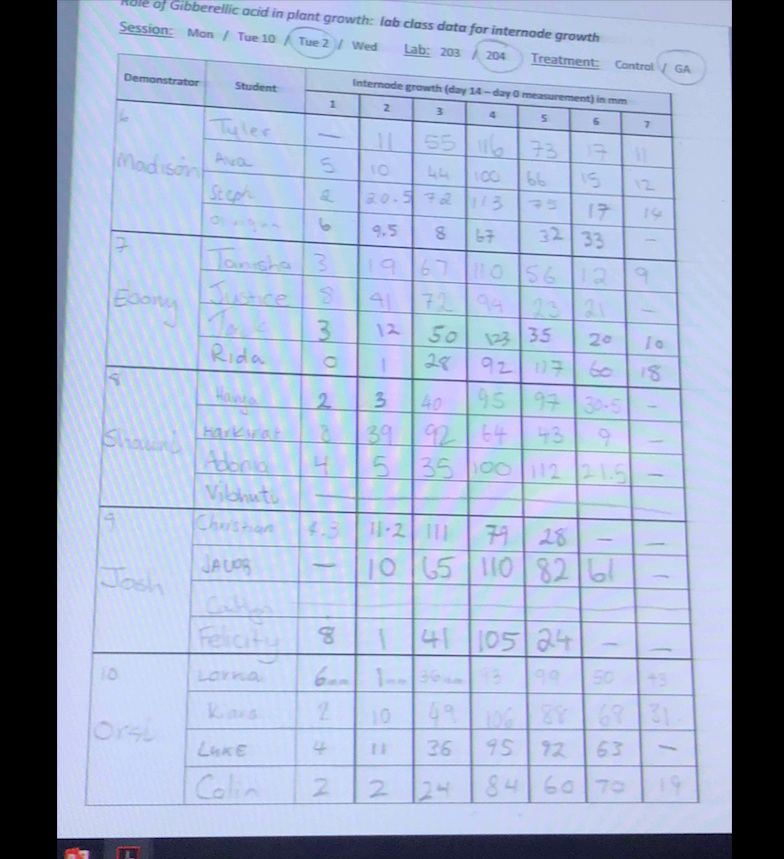
The Role of Gibberellic Acid in Plant Growth Aim: To study the effect of the gibberellic acid application on plant growth. To do this you will set up control and treatment plants. Control plants will be sprayed with water and treatment plants with gibberellic acid (GA) Plants: Your group will use two pots each containing a seedling of Pisum sativum variety William Massey, which is a dwarf variety. The dwarf plants are deficient in gibberellic acid (GA) due to mutation of a gene in the pathway for biosynthesis of GA. Procedure 1. As much as possible, your two plants should match for height. 2. The plant in the square pot will be the control (C) and the plant in the round pot the treatment 3. Label each plant and pot with the appropriate information. Use a pencil for writing labels (pencil does not run/wash off). Using stickers, label the pots with your prac day & time and the seat no. for one member of your group. Using jeweler’s tags label the plants either C or T, depending on pot shape 4. Carefully measure internode length in millimetres. The first internode is the distance between the first node (where the cotyledons were attached) and the second node where the membranous scale leaves are attached. The second internode is the distance between the second node (where the membranous scale leaves are attached) and the third node where the first trifoliate leaf is attached. You may need to use a Vernier caliper if internodes are small. See Appendix I for how to use Vernier calipers. Note, there should be three to four internodes 5. Record the measurements for each plant’s internode length separately in Table P1.1 (next page) under Day 0. If you do not have measurements (i.e. for internodes not yet present) put zero
Describe in chronological order the steps of the antigen-processing and antigen-presentation pathways for intracellular, cytosolic pathogens.
Describe in chronological order the steps of the antigen-processing and antigen-presentation pathways for intracellular, cytosolic pathogens.
Describe the structure of an antibody molecule and how this structure enables it to bing to a specific antigen. Include the following terms in your description: heavy chain, light chain, variable region, constant region, antigen-binding site, and hypervariable region.
Identify five important components used for the Pediatric Basic Screening Survey when assessing a child’s oral health status
a. A 6-month dental care appointment
Sealant on permanent molars
Presence of treated decay
A fluoride vanish treatment
A child’s first visit to the dentist
Presence of untreated decay
Early childhood caries presence
The urgency of need for dental care
What is a BSS Basic Screening Survey? a. A survey to access the oral needs of school children or adults including a visual inspection of the mouth
b. a visit to the dentist
c. a thorough clinical dental exam
d. a medical evaluation of a child or adult
2. The Basic Screening Survey BSS identifies and records the following:
Identify all that apply
a. Obivious dental decay
b. A tooth that is lost due to decay
c. Sealants on permanent molars
d. Interproximal caries on dental radiographs
e. All choices are correct
3. The Basic Screening Survey is often an underestimate of actual dental disease present
True
