Critically analyze pain and medication management in the treatment of your patient, including associated risk management
Critically analyze pain and medication management in the treatment of your patient, including associated risk management.

Critically analyze pain and medication management in the treatment of your patient, including associated risk management.
Should all promises be enforced by law? Why or why not? Discuss your opinion on the reason why we enforce some promises and we do not enforce others. Also, discuss the key concepts about sources of contract law and the nature of enforcing promises from the lesson.
A 43-year-old man presents to an acute care clinic following motor vehicle accident. He is visibly shaken, and your initial assessment rules out life- or limb- threatening injuries. On secondary assessment you notice coarse facial features including a prominent jaw, very large hands and feet, and a husky voice.
Upon examination of the cranial nerves, you’re sure he has a definite loss of lateral peripheral vision in both eyes. This leads you to inquire about the details of the motor vehicle accident, to which he says he didn’t see the other car. You then ask to see the photo of his driver’s license.
The photo is only 9 years old, but the pictured facial features are quite normal. The patient is 5’9” and weighs 180 lbs. With further questioning you learn that his shoe size, glove size, and ring size have been increasing in recent years.
You tell him you think the accident did not hurt him, but you would like to refer him to an optometrist for formal visual field testing. You suspect that, in the end, this patient will need to see a neurosurgeon.
Questions:
1. What condition do you think this patient may be suffering from? Explain your rational.
2. On the basis of the MR image below (arrow), how can you explain the vision loss?
3. What is the treatment for the condition the patient is suffering from?
Evidence-Based Report PICOT Develop A Clinical Question For Your Assigned Specialty Area. It Is Expected That Each Of The Sections Is Completed Using Correct Grammar And Spelling. 1. Intervention 2. Therapy 3. Prognosis/Prediction 4. Diagnosis Or Diagnostic Tests 5. Etiology 6. Meaning
Evidence-Based Report PICOT
Develop a clinical question for your assigned specialty area. It is expected that each of the sections is completed using correct grammar and spelling.
1. Intervention
2. Therapy
3. Prognosis/Prediction
4. Diagnosis or Diagnostic Tests
5. Etiology 6. Meaning
It Is Important That You Copy/Paste The Keywords Because The Blanks Are Casesensitive. The Hypothalamus Has Neurosecretory Neurons That Produce The Hormone . In Response, The Anterior Pituitary Releases Two Hormones Known As . FSH Will Act On The To Initiate
This problem has been solved!
You’ll get a detailed solution from a subject matter expert that helps you learn core concepts.

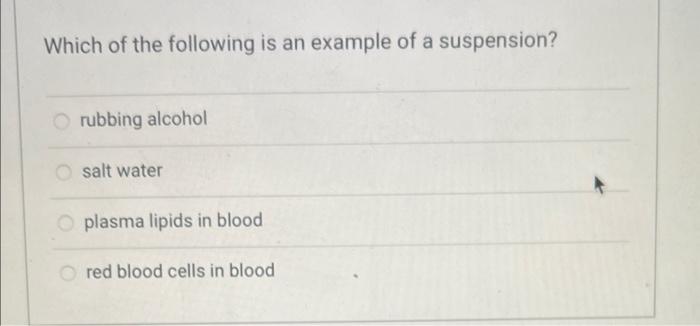
Which Of The Following Is An Example Of A Suspension? Rubbing Alcohol Salt Water Plasma Lipids In Blood Red Blood Cells In Blood
You’ll get a detailed solution from a subject matter expert that helps you learn core concepts.
Which of these are correct?
Keywords: Degenerates; Negative Feedback Inhibition; Secretory; Menstrual Flow; Implantation; Corpus Luteum; Progesterone Keywords: LH; Ovary; Hypothalamus; Ovulation; Endometrial; Estrogen; Pituitary
You’ll get a detailed solution from a subject matter expert that helps you learn core concepts.


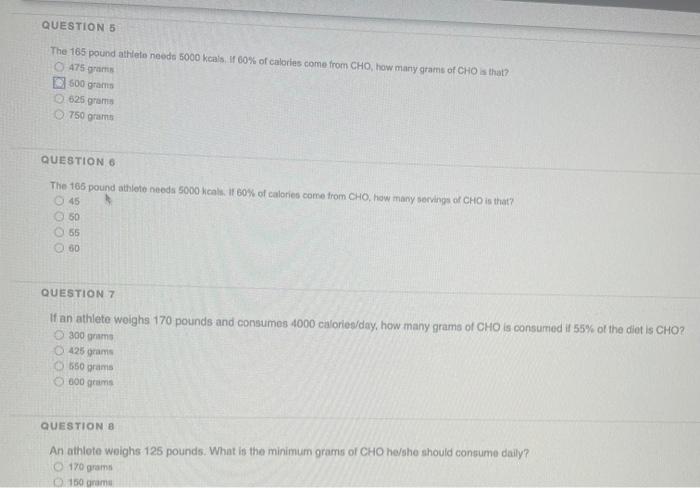
The 165 Pound Athlete Needs 5000 Keals. If \( 60 \% \) Of Calories Come From \( \Mathrm{CHO} \), How Many Grams Of \( \Mathrm{CHO} \) A That? |475-Gramis 600 Grams 625 Grams 750 Grams QUESTION 6 The 185 Pound Athlete Needs 5000 Keaks If \( 60 \% \) Of Calones Come From CHO, How Many Sonings Of CHO Is That? \( \Begin{Array}{R}\Hline 45 \\ \Hline 60 \\ \Hline
You’ll get a detailed solution from a subject matter expert that helps you learn core concepts.
CASE STUDY 1 Examination of blood smears is a valuable diagnostic tool. Imagine that you are a medical lab tech. working in a hematology lab. In front of you are four blood smears from four different patients. You notice certain abnormalities in each blood smear (indicated by the arrow) or an increase in a type of blood cell.
Below are relevant medical histories of the patients:
Patient 1: Clinical manifestations: shaking chills with profuse sweating, high fever, muscle fatigue. The patient has recently visited sub-Saharan Africa.
Patient 2: Clinical manifestations: chronically elevated blood pressure, erythromelalgia (red and swollen limbs), enlarged spleen. The patient has recently suffered from several strokes.
Patient 3: Clinical manifestations: frequent painful episodes involving joints, dark urine, muscle fatigue. The patient is African-American.
Patient 4: Clinical manifestations: frequent infections, subdermal bleeding (bruising of skin), muscle fatigue. The patient is scheduled for a bone marrow transplant.
Questions:
1. Match each blood smear to a specific patient.
2. Which disease is each patient suffering from?
3. For Patients 1 and 3 what is the cause of disease? For Patients 2 and 4 what is the treatment?
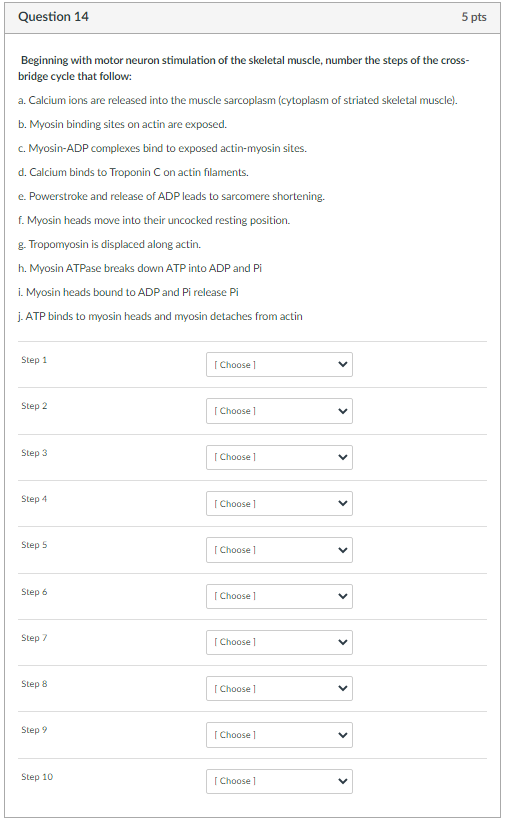
Beginning With Motor Neuron Stimulation Of The Skeletal Muscle, Number The Steps Of The Crossbridge Cycle That Follow: A. Calcium Ions Are Released Into The Muscle Sarcoplasm (Cytoplasm Of Striated Skeletal Muscle). B. Myosin Binding Sites On Actin Are Exposed. C. Myosin-ADP Complexes Bind To Exposed Actin-Myosin Sites. D. Calcium Binds To Troponin \(
This problem has been solved!
You’ll get a detailed solution from a subject matter expert that helps you learn core concepts.