How has a Hinge joint been defined in terms of its ability to “resist” movement?

How has a hinge joint been defined in terms of its ability to “resist” movement? Provide a thorough description of a “true” anatomical, Orthotic or Prosthetic hinge joint.
(Hint: “AFO” is not a thorough description)
c) Why might (single) Hinge Joints on a KAFO or prosthesis with Joints and Thigh Lacer induce shear
forces on
the wearer’s skin? How might this be prevented? What could be used to prevent/reduce shear?

What is the Normal blood pressure response whỉe performing aerobic exercise

What is the normal blood pressure response whỉe performing aerobic exercise of increasing intensity compared with at rest? initial increase in systolic BP, then leveling off of systolic BP steady increase in systolic BP throughout exercise and smali change in diastolic BP increase in systolic BP and increase in diastolic BP of greater thansteady increase in both systolic and diastolic BP throughout exercise

Question 14 Which of the following causes hemoglobin to release more oxygen to the cell? an increase in body temperature inspiring a rich oxygen mixture at sea level a decrease inaround the working coll a decrease in blood acidity

Question 15 1 pts During aerobic exercise, what changes happen to heart rate and stroke volume, and why compared with at rest? decrease in heart rate and increase in stroke volume due to increased parasympathetic activity decrease in heart rate and decrease in stroke volume due to increased parasympathetc activity decrease in heart rate and decrease in stroke volume due to increased sympathetic activity increase in heart rate and increase in stroke volume due to increased sympathetc activity

The Osmolarity Tonicity And What Will Occur To A Cell Placed In The Following Solutions

Provide The Osmolarity, Tonicity And What Will Occur To A Cell Placed In The Following Solutions: 200 MM KCl 100 MM MgCl2 200 MM CaCl2

This problem has been solved!

You’ll get a detailed solution from a subject matter expert that helps you learn core concepts.

Provide the osmolarity, tonicity and what will occur to a cell placed in the following solutions:

  1. 200 mM KCl


  1. 100 mM MgCl2


  1. 200 mM CaCl2

Hline Weight Lifting

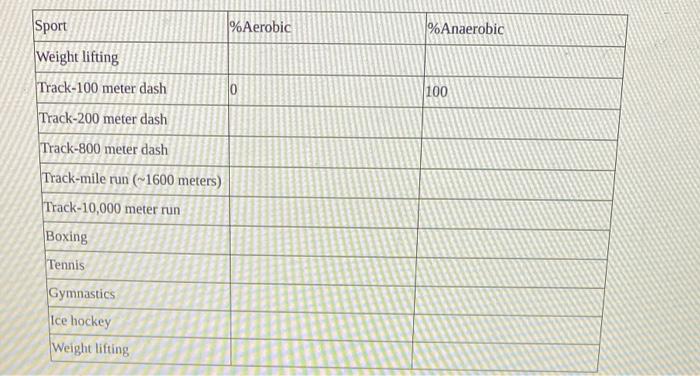
Begin{Tabular}{|L|} \Hline Sport \\ \Hline Weight Lifting \\ \Hline Track-100 Meter Dash \\ \Hline Track-200 Meter Dash \\ \Hline \End{Tabular} Track-800 Meter Dash Track-Mile Run ( 1600 Meters) Track-10,000 Meter Run Boxing Tennis Gymnastics Ice Hockey Weight Lifting Assignment: Bioenergetics Assignment Background And Learning Objectives: Cells Are

This problem has been solved!

You’ll get a detailed solution from a subject matter expert that helps you learn core concepts.

\begin{tabular}{|l|} \hline Sport \\ \hline Weight lifting \\ \hline Track-100 meter dash \\ \hline Track-200 meter dash \\ \
Assignment: Bioenergetics Assignment Background and Learning Objectives: Cells are capable of converting foodstuffs into a bi

Compare the Health of first-year medical students with the health of last-year medical students

To study and compare the health of first-year medical students with the health of last-year medical students, suppose researchers surveyed 111 first-year students from the Faculty of Medicine of the University of Porto, Portugal and 125 last-year students from the same University. The students volunteered for the study, and it was offered to all of the first- and last-year students.

They were asked questions about how they rated their health on a scale of 1 to 5 , how many hours they sleep at night, and how often they have been sick in the last year. a) Is this study an observational study or an experiment? Explain your answer. b) Describe the three types of data they are collecting.

Are they quantitative or qualitative? What level of measurement is each type of data: nominal, ordinal, interval, or ratio? c) Could this sampling design be described as simple random sampling? Explain. d) Are there any possible sources of bias in this study? Explain. 5) a) Explain what sampling bias is.

Then, for each of the following (b-e) identify the sampling technique used and discuss potential sources of bias (if any). Justify your answers. b) A student finds 18 friends to participate in a psychology experiment.

c) Two hundred people, 50 from each of four weight groups: underweight, normal weight, overweight, and obese, are studied and given a health score. d) Researchers interview all pregnant women in eleven randomly selected neighborhoods in the district of Northern Ethiopia to study their level of awareness of danger signs. e) Using random digit dialing, researchers ask 987 U.S. adults whether they feel comfortable wi their current financial plans for retirement. 6) Explain what a random double-blind controlled experiment would be.

Anterior Cruciate Ligament Tears

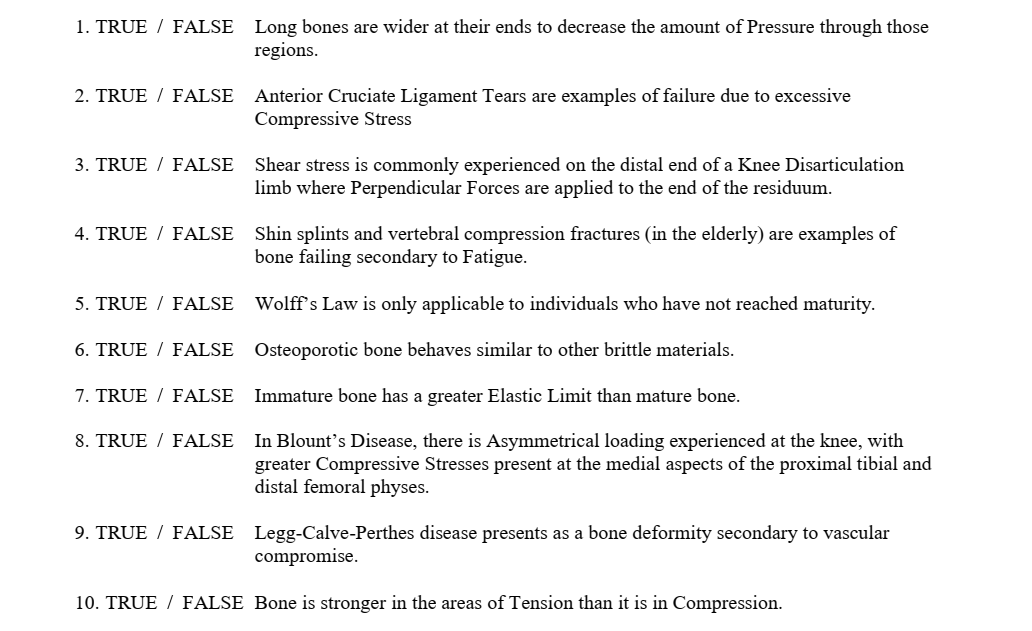
TRUE / FALSE Long Bones Are Wider At Their Ends To Decrease The Amount Of Pressure Through Those Regions. 2. TRUE / FALSE Anterior Cruciate Ligament Tears Are Examples Of Failure Due To Excessive Compressive Stress 3. TRUE / FALSE Shear Stress Is Commonly Experienced On The Distal End Of A Knee Disarticulation Limb Where Perpendicular Forces Are Applied

This problem has been solved!

You’ll get a detailed solution from a subject matter expert that helps you learn core concepts.

1. TRUE / FALSE Long bones are wider at their ends to decrease the amount of Pressure through those regions. 2. TRUE / FALSE

How does osteoporosis affect the Material properties of bone?

How does osteoporosis affect the material properties of bone? (… Strength, Elastic/Plastic Deformation, ability to permit Strain, Brittleness/Ductility) b) What role could Wolff’s Law play in the development of, or prevention of, osteoporosis?

Describe the Heuter-Volkmann Principle

Describe the Heuter-Volkmann Principle. b)What areas of the bone are affected? How can these negative effects be alleviated? c)How are the Heuter-Volkmann Principle and Wolff’s Law similar and how are they different?


13a) What kind of forces can muscle and soft tissue experience?… apply? (Tensile / Compressive)
b) What are some positive results of this application?
c) What are some detrimental effects of this application?

Draw the Deformity in the sagittal plane

a) Describe Plantar Fasciitis. b) Draw the deformity in the sagittal plane and clearly label the illustration, including the
3-Point Force
System that you would apply to the foot/ankle to correct this deformity if your intent were to
encourage
ankle dorsiflexion.
c) Clearly describe the point of application and direction(s) of these forces.

Describe Cubital Tunnel Syndrome

Describe Cubital Tunnel Syndrome. b) Draw the deformity in the sagittal plane and clearly label the illustration, including the 3-Point Force System that you would apply to correct this deformity if your intent were to prevent elbow flexion. c) Clearly describe the point of application and direction(s) of these forces.