The Fetal Vertebral Column

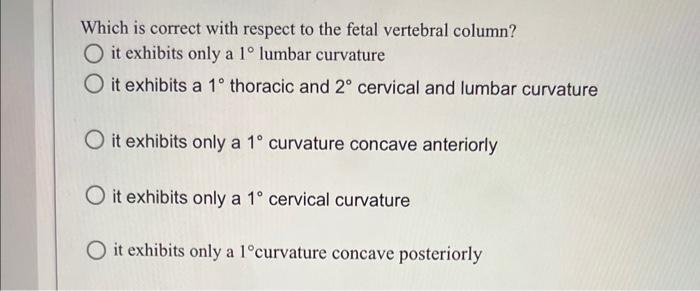
Which Is Correct With Respect To The Fetal Vertebral Column? It Exhibits Only A \( 1^{\Circ} \) Lumbar Curvature It Exhibits A \( 1^{\Circ} \) Thoracic And \( 2^{\Circ} \) Cervical And Lumbar Curvature It Exhibits Only A \( 1^{\Circ} \) Curvature Concave Anteriorly It Exhibits Only A \( 1^{\Circ} \) Cervical Curvature It Exhibits Only A \( 1^{\Circ} \)

This problem has been solved!

You’ll get a detailed solution from a subject matter expert that helps you learn core concepts.

Which is correct with respect to the fetal vertebral column? it exhibits only a \( 1^{\circ} \) lumbar curvature it exhibits

Show transcribed image text

The Gibbs-Donnan Equilibrium

Assume You Know The Following Initial Ion Concentrations And Charges: C) (5 Points) What Is The Nernst Potential For Sodium And Chloride Given The Final Concentrations After The Gibbs-Donnan Equilibrium Is Reached? (You Can Use Your Estimated Values If You Couldn’t Calculate The Exact Values). You Can Assume RT/F

This problem has been solved!

You’ll get a detailed solution from a subject matter expert that helps you learn core concepts.

can you solve these questions please?

Problem 4 ( 30 points \( +5 \) bonus points) Assume you know the following initial ion concentrations and charges:
C) (5 points) What is the Nernst potential for sodium and chloride given the final concentrations after the Gibbs-Donnan equi

Show transcribed image text

Interagency coordinated care

I am discussing the implementation of my chosen project plan for a chosen population- which is the development of a home hospice within my healthcare organization for our end-of-life patients. The question is: Articulate your vision of interagency coordinated care for this population. Consider how you would organize and consolidate care for this population.

I am stuck on how I would “consolidate” care

Inspection of the patient’s breathing patterns

My focused respiratory assessment included full vital signs, and an inspection of the patient’s breathing patterns, skin color, and respiratory status, also I did palpate to see if there were any abnormalities and listened to her lung sounds using a stethoscope. My patient’s vitals were normal, the only thing her oxygen was dropping to 93% but went back up to 95%, her blood pressure was also elevated at 161/85 but she has a history of Hypertension and is on BP meds and she has been running a little high.


Exploratory method of research

Qualitative and Quantitative studies are very different in their methods of collecting data. On one hand, qualitative data is collected through observations, one-on-one interviews, and focus groups, to name a few, and is non-numerical in nature. It is an exploratory method of research that produces results that are not easy to generalize.

On the other hand, quantitative studies collect data through surveys, polls, or questionnaires that are sent out to a specific section of a population and are then statistically analyzed. The results from quantitative studies are easier to generalize. It is no wonder why some researchers believe that both methods should be used when conducting research as they can be used to support the research question; thereby, increasing the reliability of the study (as stated in the discussion prompt). Mixed method research (MMR) is a newer approach to research in which qualitative and quantitative techniques are ‘mixed’ together within a single study or investigation

Traumatic fracture of the body mandible

A patient was seen in the ED one week ago due to suffering a traumatic fracture of the body mandible, on the left side.  He is being seen today by a maxillofacial surgeon for a pre-op visit. NOTE: Assign only the injury code. This is not the patient’s first medical encounter with this injury. Guidelines direct us to code the place of occurrence and activity codes only on the initial visit.

The delivery of a term infant

A respiratory therapist is called to attend the delivery of a term infant. The mother has had no prenatal care and reports that her “water broke” several days ago. Immediately following vaginal delivery, the infant was placed on a preheated radiant warmer and dried with warmed towels. The infant was placed in a sniffing position and assessed. The following data are available at 1 minute of age:
Respiratory rate: 15 breaths per minute, with weak, irregular effort
Color: Pale, with central cyanosis
Response to stimuli: Grimace
Muscle tone: Limp
Heart rate: 97 beats per minute


1. Which of the following should the respiratory therapist do first?
a. Provide 100% free-flow oxygen
b. Intubate the trachea
c. Provide bag-mask ventilation
d. Initiate chest compressions

2. What is the 1-minute Apgar score?
a. 0
b. 1
c. 3
d. 5

Subcostal and intercostal retractions

You are called to the delivery room at 2:00 a.m. for a laboring gravida 1 para 0 mother at 28 weeks gestation. The mother had good an-
prenatal care and had a normal integrated prenatal screening (IPS), normal 20-week ultrasound, and protective serology, including rubella immune, human immunodeficiency virus (HIV) negative, venereal disease research laboratory (VDRL) negative, and hepatitis negative. Group B Streptococcus (GBS) status is unknown as the woman had not yet had swabs done. Social history was negative for tobacco, alcohol, or recreational drug use during the pregnancy. She has gestational diabetes mellitus, which was reasonably controlled by diet and exercise
alone.

You arrive at the delivery room moments before the baby is born and prepare equipment for a potential resuscitation, which includes oxygen, a bag and mask, suction, towels to dry, and intubation equipment. At birth, the newborn cries spontaneously. She is placed on the warmer to be dried and stimulated; her heart rate is 120 beats per minute and her respiratory rate is 60 breaths per minute. The infant grunts intermittently. At 4 minutes of age, the newborn has both subcostal and intercostal retractions, nasal flaring, and continuous grunting. Her respiratory rate is now 82 breaths per minute and her heart rate is 190 beats per minute. Oxygen saturation by pulse oximetry is 84% with blow-by oxygen. You begin providing CPAP at 6 cm H2O by mask with a t-piece resuscitator. A systolic murmur gr 2/6 is auscultated loudest at the left upper sternal border (LUSB). The infant is transferred to the NICU where she continues to receive nasal CPAP at 6 cm H2O and a FiO2 of 0.45. The chest X-ray shows a diffuse ground-glass appearance with air bronchograms. An arterial umbilical catheter (UAC) is inserted. Arterial blood gas reveals the following: pH 7.23, CO2 60, PaO2 40, HCO3 27, BE +1, and lactate 4.8.
Blood work shows white blood cell count 20.3, neutrophils 12.3, no left shift, hemoglobin 16.5, platelets 260.


1. What is the first line of therapy for this premature infant considering her presentation?
2. What are the chemical components that make up surfactants?
3. How does surfactant work in the lung?

The Biased Care Model

The Biased Care Model offers different routes to improve clinical care that can be utilized. Provide an example of a biased perception in minority healthcare that may impact patient outcomes and how the use of the Biased Care Model can help to facilitate change and improve clinical care.

Create a plan of care for a client diagnosed with the bacterial pneumonia

Create a plan of care for a client diagnosed with the bacterial pneumonia-must list at least two priority diagnoses (one of them physiological and one health promotion).

The care plan must include the following: For each diagnosis provide at least 3 interventions; at least three goals/plans; at least 3 evaluation criteria; at least three interventions for each.

Complete patient education must address the prevention of adverse/side effects of treatment and health promotion; there should be a minimum of 4 teaching points. The patient education section should be completed in full.


Below is the patient information


Male, 01/31/1960 (62 years old), 173 cm, 63 kg


MRN: 26236


Attending: John Mack, MD

Allergies:

Demerol

Code Status: Full

Comments: none


  • Patient Summary
  • Patient Information
  • Results
  • Provider
  • Allergies & Home Medications
  • Immunization Record
  • Notes
  • Flowsheets
  • Screenings
  • MAR
  • Orders
  • Patient Education
  • SBAR
  • Care Plan
  • Disch

  EXPAND

Patient Summary


Primary Concern: Pneumonia

The Patient Summary is read only! To add or edit data you must open another page by clicking the appropriate tab to the left.

Vital Signs

01/31/2022 2122
Heart Rate 106
Blood Pressure 90/60
Respirations 32
Temperature 36.89°C (Tympanic)
SpO2 (%) 90%
Pain 3

Allergies

Allergy Date Noted Reaction
Demerol Hives

Orders

Type of order to view:

All DietImagingLabMedicationNursing/Other OrdersRespiratory


Search:


Show 102550100 entries

  • Previous
  • 1
  • 2
  • Next


Start Date Order Details Status All ActivePast End
01/31/2022 1823 Activity-Bedrest with bathroom privileges

Written order
Frequency: Continuous

Start Date: 01/31/2022 1823
End Date: 01/31/2022 1823

Past End
01/30/2022 2223 AMOXICILLIN

Written order
Dose/Frequency: 500 mg 2x Daily
Route: Oral

Start Date: 01/30/2022 2223
End Date:

Schedule: 0800, 2000 Active
01/31/2022 1823 Antiembolism stockings (TED) knee high

Written order
Frequency: Continuous

Start Date: 01/31/2022 1823

Active
01/31/2022 1823 Arterial Blood Gases (ABG)

Written order
Frequency: Once
Duration: 1

Start Date: 01/31/2022 1823

Active
01/30/2022 2223 ATORVASTATIN

Written order
Dose/Frequency: 20 mg Daily
Route: Oral

Start Date: 01/30/2022 2223
End Date:

Schedule: 2200 Active
01/31/2022 1823 Diet – Regular

Written order
Frequency: Continuous

Start Date: 01/31/2022 1823

Active
01/31/2022 1823 Full code

Written order
Frequency: Continuous

Start Date: 01/31/2022 1823

Active
01/31/2022 1823 Insert Intermittent Infusion Device (saline lock, med lock, hep lock)

Written order
Frequency: Continuous

Start Date: 01/31/2022 1823

Active
01/30/2022 2223 MORPHINE SULFATE

Written order
Dose/Frequency: 4 mg Every 8 Hours
Route: Intramuscular

Start Date: 01/30/2022 2223
End Date:

Schedule: 0800, 1600, 0000 Active
01/31/2022 1423 Oxygen-nasal cannula 2L/min

Written order
Frequency: Continuous

Start Date: 01/31/2022 1423

Active

Showing 1 to 10 of 14 entries

  • Previous
  • 1
  • 2
  • Next


Labs

Lab Range 01/31/2022 2032
Arterial Blood Gases (ABG)
pH 7.35 – 7.45 7.28
Carbon dioxide partial pressure (PCO2) (mm Hg) 35-45 mm Hg 56
Oxygen partial pressure (PO2) (mm Hg) 80-100 mm Hg 70
Bicarbonate (HCO3) (mEq/L) 22 to 26 mEq/L 25
Carbon Dioxide (CO2) (mEq/L) 23-28 mEq/L
O2 Saturation (%) 95% – 98% 89