How Capillaries Exchange Nutrients And Wastes With Tissue Cells

Describe IN DETAIL The Process Of How Capillaries Exchange Nutrients And Wastes With Tissue Cells. Do not focus On The Exchange Of Oxygen And Carbon Dioxide Specifically, But The Exchange Of Nutrients And Wastes In general. This Should Include Terms Such As Filtration And Osmosis (And The Important Terms That We Discussed in Inclass: Net Osmotic Pressure And

This problem has been solved! You’ll get a detailed solution from a subject matter expert that helps you learn core concepts.
The human respiratory system

The human respiratory system is critical to immediate survival. The key to understanding respiration function lies in the laws of gases. List two functions of components of the respiratory system

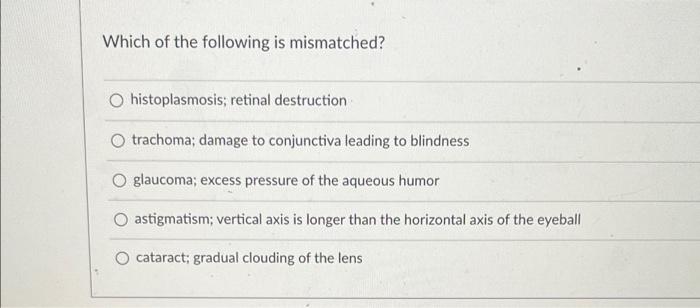
Which of the following is mismatched

Which of the following is mismatched? O histoplasmosis; retinal destruction O trachoma; damage to conjunctiva leading to blindness glaucoma; excess pressure of the aqueous humor astigmatism; vertical axis is longer than the horizontal axis of the eyeball cataract; gradual clouding of the lens

Which of the following is mismatched? O histoplasmosis; retinal destruction O trachoma; damage to conjunctiva leading to blin

Explain how glucose is transported

Explain how glucose is transported from one side of the cell to the other (steps 1 &2). Make sure to mention where energy is needed. Also, discuss the role of the Na+/K+ pump. 2. Discuss the concept of saturation with respect to the transporter in step 1

The conversion of stimulus energy into electrical

The conversion of stimulus energy into electrical energy that can be propagated as a nerve signal is a function of the______?

The non-noxious cutaneous sensation

The non-noxious cutaneous sensation is mediated by which general types of sensory neurons? (A) Rapid non-adapting and slow adapting neurons (B) Slow non-adapting and Rapid adapting neurons (C) Rapid adapting and rapid non-adapting neurons (D) Slow non-adapting and slow adapting neurons (E) Rapid adapting and slow adapting neurons Question 23 Which of the following receptor types encodes for the onset of a stimulus and has a small receptive field? (A) Free nerve ending (B) Ruffini ending (C) Pacinian corpuscle (D) Merkel disk E) Meissner’s corpuscle 2 Points 2 Points

Cutaneous sensory physiology perspective

How do you interpret these findings from a cutaneous sensory physiology perspective? Use the editor to format your answer to Question 33 Indicate as True or False whether the following factors could have influenced the observations made on the Neuroscience practical data. Merkel disk receptor density A True B) False Question 34 Pacinian corpuscle receptor density 1 Point A True Indicate as True or False whether the following factors could have influenced the observations made on the Neuroscience practical data. B False 1 Point 1 Point

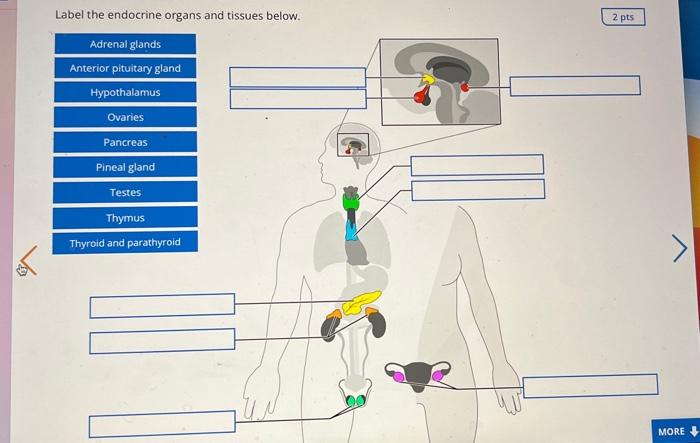
Label the endocrine organs and tissues below

Label the endocrine organs and tissues below. Adrenal glands Anterior pituitary gland Hypothalamus Ovaries Pancreas Pineal gland Testes Thymus Thyroid and parathyroid C. 2 pts Label the endocrine organs and tissues below. Adrenal glands Anterior pituitary gland Hypothalamus Ovaries Pancreas Pineal gland Testes Thymus Thyroid and parathyroid 2 pts MORE

Label the endocrine organs and tissues below.
Adrenal glands
Anterior pituitary gland
Hypothalamus
Ovaries
Pancreas
Pineal gl

Peripheral vasoconstriction

Which of the following concerning peripheral vasoconstriction (PV) during the diving reflex, when carrying out facial immersion with a snorkel is correct? An Apnea and inhibition of the respiratory muscles play a fundamental role B) PV is dependent on the vagal control of blood vessels A pontine neuronal network in the brain activates the sympathetic nervous system to induce PV Sensory information relayed via the NTS activates cells in the IML of the spinal cord which in turn promotes sympathetically induced PV. Activation of the NTS neurons projecting to the nucleus ambiguous is essential for Section 4: Reflex Physiology (Questions 13-20) Question 13 Which afferent and efferent neurons are principally involved in the stretch reflex? A Group la afferents and gamma motoneurones B Group Ib afferents and alpha motoneurones Group la afferents and alpha motoneurones D Group II and gamma motoneurones Group II and alpha motoneurones Question 14 The stretch reflex is characterised as being an? Excitatory disynaptic reflex B) Inhibitory monosynaptic reflex 2 Points Inhibitory disynaptic reflex D Excitatory monosynaptic reflex Excitatory polyphasic reflex 2 Points 2 Points

Condition of the integumentary system

find and describe a disease or condition of the integumentary system that you find interesting. See if you can find one that is less common or one you haven’t heard of before, so we can all learn something new! Possible things to include might be causes, symptoms, treatments, who tends to be affected, etc. Be sure to include some anatomy and physiology in your description. 200-word maximum.