Experiencing some Loss of balance

Silgi presents to the neurologist as he is experiencing some loss of balance, weakness and a ‘funny feeling’ in his face, body, arms and legs. Neurological examination reveals the following (examination findings have been numbered for easy identification in your written responses). test finding 1: Loss of fine touch sense on right side of the body below the neck (includes right upper and lower limbs) test finding

2: Loss of ability to distinguish hot and cold on right side of the body below the neck (includes right upper and lower limbs) test finding 3: Loss of pain and temperature sense on the left side of face test finding 4: Weakness/loss of strength in the right upper limb, right lower limb and right trunk muscles. Facial muscles are not experiencing weakness or problems on either side.

Consider the information above and answer the following questions. Ensure you clearly state which question is being answered in your entered responses. Answers should be written clearly and concisely and in your own words. Bullet points are suitable for listing key points.

Which specific neuroanatomical structure might be affected that would explain EACH examination finding? You should include a brief justification statement with your listed structure for each examination finding.

What do the examination findings tell you about WHERE (in terms of anatomical area) the lesion/problem is most likely to be located? You need to consider sensory and motor pathways to answer this question.

Given your responses to the above – where is the problem/lesion likely to be located that explains ALL the provided examination findings?

Myocardial infarction

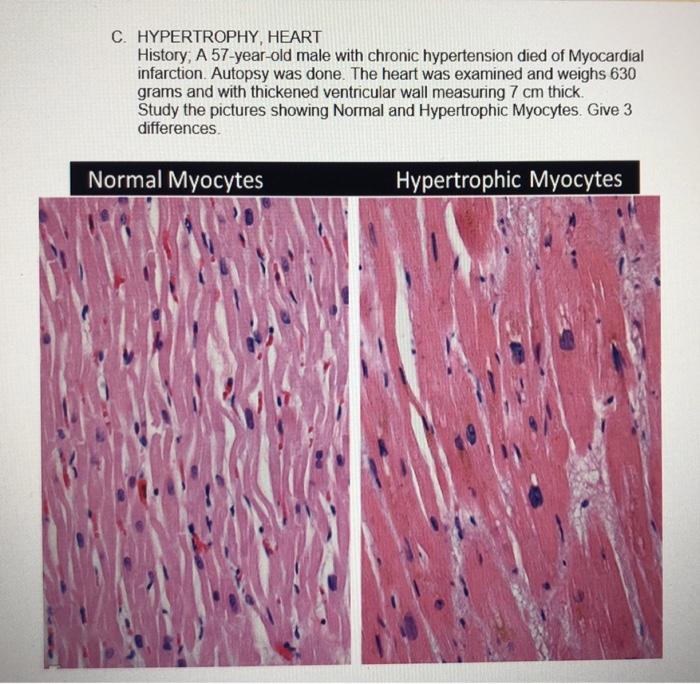
HYPERTROPHY, HEART History, A 57-year-old male with chronic hypertension died of Myocardial infarction. Autopsy was done. The heart was examined and weighs 630 grams and with thickened ventricular wall measuringthick. Study the pictures showing Normal and Hypertrophic Myocytes. Give 3 differences.

ASAP PO THANK YOU!

C. HYPERTROPHY, HEART History, A 57-year-old male with chronic hypertension died of Myocardial infarction. Autopsy was done.

S

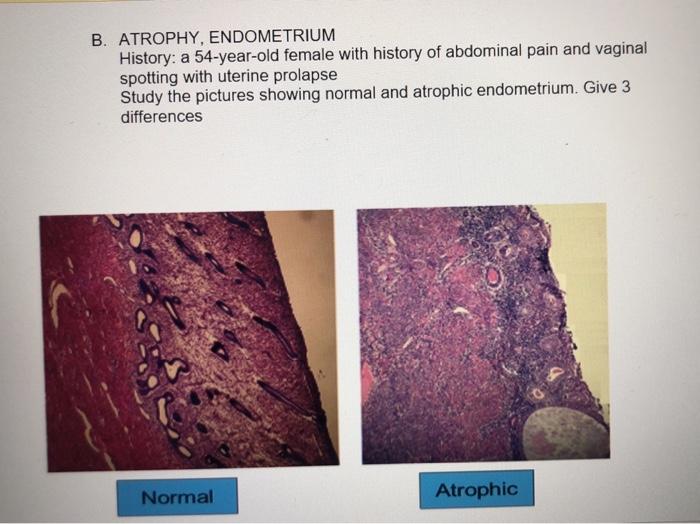
Abdominal pain and Vaginal spotting with uterine prolapse

A 54-year-old female with history of abdominal pain and vaginal spotting with uterine prolapse Study the pictures showing normal and atrophic endometrium. Give 3 differences
ASAP PO THANK YOU!
B. ATROPHY, ENDOMETRIUM History: a 54-year-old female with history of abdominal pain and vaginal spotting with uterine prolap

S

 Rubric Dietary Reference Intakes Grading

Rubric Dietary Reference Intakes Grading Rubric Criteria Ratings Pts This criterion is linked to a Learning OutcomePlan includes all food groups.​ 20 pts Full Marks 0 pts No Marks 20 pts This criterion is linked to a Learning OutcomeDetails of Plan Healthy plan includes appropriate portions to meet your nutrient needs.​

20 pts Full Marks 0 pts No Marks 20 pts This criterion is linked to a Learning OutcomeMechanics Organized, easy to interpret plan, outside sources are cited in a bibliography, correct spelling and grammar​ 10 pts Full Marks 0 pts No Marks 10 pts Total Points: 50

Dietary Reference Intakes Grading Rubric

Dietary Reference Intakes Grading Rubric

Criteria Ratings Pts This criterion is linked to a Learning OutcomePlan includes all food groups.​ 20 pts Full Marks 0 pts No Marks 20 pts This criterion is linked to a Learning OutcomeDetails of Plan Healthy plan includes appropriate portions to meet your nutrient needs.​ 20 pts Full Marks 0 pts No Marks 20 pts This criterion is linked to a Learning OutcomeMechanics Organized, easy to interpret plan, outside sources are cited in a bibliography, correct spelling and grammar​ 10 pts Full Marks 0 pts No Marks 10 pts Total Points: 50

The early years of Space exploration

During the early years of space exploration, our astronauts who had been floating in space would return to earth showing significant bone loss which was dependent on how long they were in space. The longer they were in space, the more bone loss was shown. Discuss how this might happen and what could be done to alleviate this condition.

History of syncope, dyspnea and Aortic stenosis

A 74-year-old male with a history of syncope, dyspnea and aortic stenosis has systolic pressure ofand diastolic pressure of. Which of the following most likely represents the pulse pressure in(first) and mean arterial pressure in(second) of the patient?

a.b.c.d.e.2 A pulse can be felt in a. arteries b. veins c. venules d. capillaries e. vena cava 3. During inspiration, the diaphragm contracts and allows air to rush into the lungs. How would a change in average airway diameter affect the speed at which the air moves?

a. Airway diameter will not impact the air speed, but will impact inspiration volume b. A decrease in airway diameter would increase the speed of air c. A decrease in airway diameter would decrease the speed of air d. The air speed during inspiration remains constant, regardless of airway diameter e.

Increase in airway diameter would decrease the speed of air 4. If an artery is partially occluded by an embolism such that its radius becomes one-half the preocclusion value, which of the following parameters will increase by a factor of 16 ? a. Blood flow b. Resistance c. Pressure gradient d. Capacitance e. Viscosity 5.

A 60 -year-old male painter with severe chest pain is found to have atherosclerosis of his coronary arteries. What type of cells were most likely injured in the initial stage of his disease? a. Myocytes b. Fibroblasts c. Endothelial cells d. Smooth muscle cells e. Neutrophils 6.

Which of the following statements is TRUE concerning resistance to flow a. For vessels arranged in parallel, the individual resistance’s are less than the total resistance of the system b. For vessels arranged in series, the total resistance is determined by summing the reciprocals of the individual resistance’s c.

An increase in hematocrit would decrease resistance to flow d. The greatest resistance to flow in the cardiovascular system can occur in the arterioles e.

Flow is directly proportional to resistance 7. What is the reason for the drastic drop in velocity seen in the capillary of the graph below? a. Decrease in cross-sectional area of the aorta b. Increased cross-sectional area in the capillaries c. Increased compliance of the veins d. Increased resistance in the arterioles a Manmased compliance of the aorta. 8. Which is true of the pulmonary circuit? a. Blood oxygen content is higher in the pulmonary vein than in the pulmonary artery. b. Blood is pumped through it by the left ventricle. c. Resting blood pressure in the pulmonary artery is normally equal to that in the aorta. d.

The cardiac output into the pulmonary circuit is approximatelyof that into the systemic circuit. e. Both aorta and pulmonic veins are part of pulmonary circuit system. 9. At which site is systolic pressure the lowest? a. Capillary b. Right atrium c. Aorta d. Renal artery e.

Pulmonary artery 10. In polycythemia (a disease state in which the proportion of blood volume that is occupied by red blood cells increases), the increase in red blood cell production will result in which of the following: a. flow is increased b. resistance to flow would decrease c. decrease in heart work d. Reynold’s number will decrease e. viscosity is reduced 11.

Four blood vessels are arranged in series, each with a resistance value of 10 . What is the value of total resistance? a. 10 b. 20 c. 30 d. 40 e. 50 12. A rise in blood cholesterol may lead to a deposition of cholesterol and fats on the wall of blood vessels. This causes the arteries to lose their elasticity and get stiffened. What is this called? a. Hypertension b. Hypotension c. Arteriosclerosis d.

Aortic stenosis e. Mitral stenosis 13. The walls of veins are not thick as those of arteries because a. the blood is in less quantity b. the blood is deoxygenated c. the blood is low pressured d. the blood is thicker e. the blood is thinner 14. The artery that carries deoxygenated blood is a. renal artery b. hepatic artery c. mesenteric artery d. pulmonary artery e. abdominal artery

The Voltage-gated sodium channel

What is the value of the membrane potential when the inactivation gate of the voltage-gated sodium channel closes the channel (preventing further entry of)? (A)(B)(C)(D)

Metabolism pathway in Catabolism of lipids and proteins

 The body “reuses” what part of the carbohydrate (glucose) metabolism pathway in catabolism of lipids and proteins?Fatty acids are catabolized two carbons at a time to produce [blankA] which enters the krebs cycle. hbis catabolic process is called [blankB] oxidation.
3.) Excess glucose in the liver can be stored as the carbohydrate [blankA] by a process known as [blankB], or it may be converted into [blankC] by the process known as [blankD].
thanks in advance for your help! this packet was TOUGH and maybe im just overthinking these 3 at this point.
2.) Fatty acids are catabolized two carbons at a time to produce [blankA] which enters the krebs cycle. hbis catabolic process is called [blankB] oxidation.
3.) Excess glucose in the liver can be stored as the carbohydrate [blankA] by a process known as [blankB], or it may be converted into [blankC] by the process known as [blankD].
thanks in advance for your help! this packet was TOUGH and maybe im just overthinking these 3 at this point.

What purposes do the Code of Ethics for Nurses with Interpretive Statements (Code) serve?

What purposes does the Code of Ethics for Nurses with Interpretive Statements (Code) serve? The words ethical and moral are used frequently throughout the Code, what is the meaning of these concepts and give one example of how these terms are applicable to the practice of the nurse administrator.

Explain how successful communication is used throughout a change process to convey vision and strategies to stakeholders

Explain how successful communication is used throughout a change process to convey vision and strategies to stakeholders. What may be occurring with the communication process if the change process begins to fail?