Retractions and nasal flaring

A term (41 weeks) female weighing 3100 g was born to a 30-year-old healthy gravida 2 para 1 mother by cesarean. Apgar scores were 9 and 9 at 1 and 5 minutes. The infant was initially well until day 3 of life, when she presented with tachypnea and increased work of breathing, including retractions and nasal flaring. The infant was transferred to the NICU. A complete sepsis workup was done and antibiotics were given as protocol. The infant was placed on a nasal cannula for oxygen saturation which ranged from 89-91%. Capillary blood gas was performed and revealed the following: pH 7.30, PaCO2 56 mm Hg, PaO2 45 mm Hg, HCO3 27 mEq/L, and BE 1. A chest radiograph showed mild hyperinflated lungs and mild perihilar interstitial markings. An echocardiogram was also ordered at this time, which showed an anatomically normal heart with no structural malformation. During the next 24 hours, the infant’s respiratory status worsened,
with progressive increases in work of breathing with increasing oxygen requirement. Continuous positive airway pressure was initiated by a nasal mask at 6 cm H2O and an FIO2 of 0.50. A follow-up chest radiograph was performed, which showed increasing haziness of both lung fields with air bronchograms. Capillary blood gases obtained 12 hours after nasal CPAP therapy revealed the following: pH 7.19, PaCO2 80 mm Hg, PO2 40 mm Hg, HCO3 29.5 mEQ/L, BE 1.8, and oxygen saturation 88%. Physical assessment revealed the following: temperature 37.1°C, heart rate 175 beats per minute, respiratory rate 90 breaths per minute, and blood pressure 70/40 mm Hg. The infant was
intubated and mechanically ventilated with an inspiratory pressure of 20 cm H2O, PEEP 6 cm H2O, set rate of 60 breaths per minute, and FIO2 of 0.80. Systemic examination was unremarkable except for respiratory distress. There was no clinical evidence of pulmonary hypertension. A complete sepsis workup was repeated. The white blood cell count was unremarkable. Chest radiograph following intubation
revealed a diffuse ground-glass appearance with air bronchograms. The endotracheal tube was 2 cm above the carina.


1. What therapeutic recommendation would you make based on the infant’s clinical presentation and chest radiograph?
2. Given this presentation, what diagnosis should be considered for this infant?
3. What information obtained by chest radiograph would indicate that this infant may benefit from
surfactant replacement
therapy?
 

The delivery of a term infant

A respiratory therapist is called to attend the delivery of a term infant. The mother has had no prenatal care and reports that her “water broke” several days ago. Immediately following vaginal delivery, the infant was placed on a preheated radiant warmer and dried with warmed towels. The infant was placed in a sniffing position and assessed. The following data are available at 1 minute of age:
Respiratory rate: 15 breaths per minute, with weak, irregular effort
Color: Pale, with central cyanosis
Response to stimuli: Grimace
Muscle tone: Limp
Heart rate: 97 beats per minute


1. Which of the following should the respiratory therapist do first?
a. Provide 100% free-flow oxygen
b. Intubate the trachea
c. Provide bag-mask ventilation
d. Initiate chest compressions

2. What is the 1-minute Apgar score?
a. 0
b. 1
c. 3
d. 5

Legislative requirements for the advanced practice registered nurse

Which of the following directs legislative requirements for the advanced practice registered nurse (APRN) credentialing process? Educational institutions Nursing licensing boards

Machinery requiring Amputation at the wrist

A patient mangled his left hand in machinery requiring amputation at the wrist. The wound has healed and the patient is fitted with an artificial hand. The device has a molded socket, flexible elbow hinges and triceps pad.

A total of 30 minutes was spent training the patient to use the prosthesis. What codes are reported for the prosthesis, training and diagnosis?

Acute myeloid leukemia

A patient being treated for acute myeloid leukemia asks the nurse about the future treatment options the nurse explains the patient might be a candidate for an allogeneic stem cell transplant an allogeneic transplant involves the patient receiving

The range of motion for the Femur repair

You are the nurse assigned to Mr. Jones when he is admitted to the unit after surgery. He is restricted in the range of motion for the femur repair and has a splint on his leg for the tibia fracture. He is complaining of pain 9/10 and does not want to move.
What are your concerns as a nurse about the mobility of this client?
What assistance will he require from the nursing team to provide ADLs and personal hygiene? What are your recommendations for assistive mobility devices for this client? What vital sign changes could you anticipate due to his mobility restrictions?
Mr. Jones is an 80-year-old man who lives in his apartment in a large city. His wife passed away five years ago from cancer and his adult children live in other states; the closest is a son who lives six hours away by car. Mr. Jones has kept himself quite active since his wife has died.
He goes to the senior center three or four times a week, meets up with some male friends for coffee almost every morning and on Friday nights, goes to the bingo hall to play some games. He does have someone come in to help with housework and laundry.
Last week, Mr. Jones was leaving his apartment building when a neighbor’s small dog got loose, leash trailing behind it. The dog went to jump up on Mr. Jones and in the process, Mr. Jones became tangled in the leash and fell hard on his right side. He was in significant pain and his right leg was at an odd angle. An ambulance was called to take him to the hospital. X-rays were ordered of his leg and hip.
Mr. Jones had fractured his tibia at the head with some bone displacement, and a fracture in the femoral head. Mr. Jones was taken into surgery to put a plate and screws to correct the fracture in the tibia and surgery to correct the fracture in the femoral head.

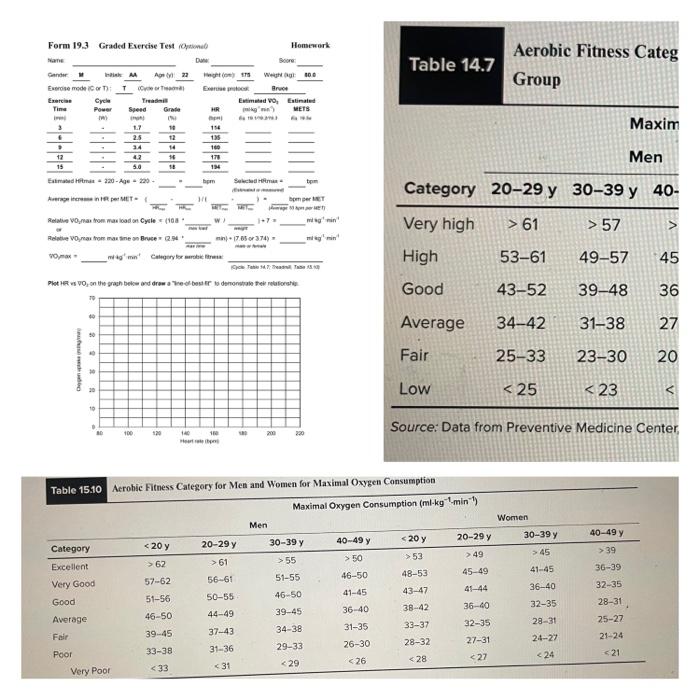
Aerobic fitness for men and women for maximal oxygen consumption

Please record data for the worksheet and fill out the graph for aerobic fitness for men and women for maximal oxygen consumption.

student submitted image, transcription available below

Show transcribed image text

The SDOH that affects the family health status

Describe the SDOH that affects the family health status. What is the impact of these SDOHs on the family? Discuss why these factors are prevalent for this family. Wellness mode outlines the steps for family-centered health promotion. Include strategies for communication.

Explain the positive and negative aspects of the living arrangements

Explain the positive and negative aspects of the living arrangements for the elderly listed below. Be sure to thoroughly evaluate each option.

  1. Living in my own home
  2. Living with their children
  3. Assisted living facility
  4. Nursing home with intermediate care
  5. Nursing home with skilled nursing care and make recommendations for healthy and disabled elderly

Traumatic fracture of the body mandible

A patient was seen in the ED one week ago due to suffering a traumatic fracture of the body mandible, on the left side.  He is being seen today by a maxillofacial surgeon for a pre-op visit. NOTE: Assign only the injury code. This is not the patient’s first medical encounter for this injury. Guidelines direct us to code the place of occurrence and activity codes only on the initial visit.