Developmental contexts of anorexia nervosa

In this exercise, you will examine the eating disorders anorexia nervosa and bulimia nervosa, including the symptoms, treatment options, and the latest research findings that are unlocking the mysteries of these disorders. You will also be introduced to the Internet Mental Health, one of the most authoritative sources of information on psychological disorders. The home page can be found at www.mentalhealth.com/p20-grp.html. Don’t limit your exploration to this site, however; rather, use it as a starting point in your investigation to find answers to the following questions.

1. Briefly summarize the online diagnosis criteria for either anorexia nervosa or bulimia nervosa.

2. Given the many developmental contexts of anorexia nervosa and bulimia nervosa, treatment must focus on the biosocial, cognitive, and psychosocial roots of these disorders. Briefly describe the treatment options available for either anorexia or bulimia. Which has proven to be most effective?

3. Using the Research section of the Web site, find out how the recovery rates differ for anorexia nervosa and bulimia nervosa.

4. Briefly summarize one article from any section of the Website.

Primary care differential diagnosis

Acute MI. Signs and symptoms :S/S: Shortness of breath, Chest pain, Fever formulate at least one different, primary care differential diagnosis as well as a lab and radiology (as applied) workup for that differential.  Your differential and diagnostic workup and treatment must be supported by peer-reviewed, recent references and resources pointing to best practices. There must be a minimum of three references per differential.

Investment in an Electronic health record system

For this assignment, you are requesting funding from the Board of Directors for an investment in an Electronic health record system. Create one summary, on a Word document, which delivers each of the 4 parts of this assignment. When combined this summary should support your funding request, by analyzing the impact a new EHR would have on the hospital’s revenue and reimbursement, on data collection, operations, and relationships both internal and external.

Assignment Requirements

  • Please complete all parts in a Microsoft Word document.
  • Quoting should be less than 10% of the entire paper. Paraphrasing is necessary.
  • Students must cite and reference at least 3 credible sources from the Library.
Part Competency Assessed Instructions
1 Apply principles of healthcare finance for revenue management. Task: Demonstrate the principles of health care finance for revenue management through the intended application of cost reporting and variances. Create a summary which covers the pros of investing in a new EHR. Include in your summary how the EHR will address topics of cost reporting and the variances seen currently.
2 Implement processes for revenue cycle management and reporting. Task: The Board of Directors will need to consider the implications of adopting a new EHR system on systems related to RCM and reporting. Use the information researched in unit 8 assignment and summarize how the three considerations you researched relate to the overall process of RCM.
3 Identify severity of illness and its impact on healthcare payment systems. Task: As part of your analysis on the implications of a new EHR system on other information systems, analyze the relationship between data quality within a new EHR and severity of illness. Identify the purpose and use of severity of illness based on information within the health record. Conclude this section of your summary by associating severity of illness and health care payment systems, integrating case-mix and CAC systems.
4 Identify the different types of organizations, services, and personnel and their interrelationships across the health care delivery system. Task: Funding request summaries often become available to the general public–either on its own or when combined into another report. Identify and discuss the connections among the different types of organizations, services, and personnel–including their interrelationships across the health care delivery system. To do this, analyze the implications of a new EHR system with both internal and external organizations.

Nursing career professional development plans

Now that each one of you is very close to completing this major accomplishment in your nursing career, please share your nursing career professional development plans to keep up to date in your chosen specialty and nursing in general.

  • In what professional nursing organizations do you currently participate?
  • What organizations might you think about participating in in the future?
  • What nursing certifications are you considering?
  • How might the consideration of continuing your education to pursue a graduate degree fit into your future plans?

The core skills of therapeutic communication

An important part of being a professional is self-assessment. The Importance of Reflection Nurses regularly reflect on their practice and ask themselves where they’re performing well and what they’d like to improve.  You will be doing this every year as part of your annual BCCNM Registration Renewal.

This reflection can be as simple as analyzing a situation with a challenging client earlier in the day or thinking about how to apply a new communication strategy they learned.

Take some time to think carefully about the questions below.  This is your opportunity to dig deep and reflect on how this course and its topics influence your way of being as a nurse and the impact(s) the skills and techniques will have on your future practice.

This is not a research assignment; this reflection must be personal and come from within with evidence that you have sat with these questions and demonstrate careful consideration.

Reflect on the following questions:

  1. Recall the Metaparadigms of Nursing concepts “Person” and “Nurse”.  Reflect briefly on how the core skills of therapeutic communication you have practiced this semester will help develop these for you in your practice.
  2. How did I personalize the evidenced-based theory into an evidence-based practice?
  3. Provide constructive feedback on your learning and practice experiences in the course.
  4. Comment on what went well and experiences that did not go well.
  5. Comment on what you will do to ensure that you keep developing the skills and techniques you have learned in this course.

The health and well-being of species

What dilemma do scientists scramble with as it is well documented that eutrophication/nutrient enrichment triggers Harmful Algal Blooms (HABs) and deteriorates water quality?

  1. To suggest solutions for overcoming challenges (possible consequences of eutrophication). Solutions can involve individual actions, economic or political strategies.

# Guidelines:Read the two articles from the links below, one from Environment Education Victoria and the other a release from a Nature Education-Knowledge Project that relate the dead zones mediated by eutrophication to indiscriminate use of insecticides, pesticides, and fertilizers. # Answer the following two questions-Thoroughly justify your answer by examining both your position and the opposing viewpoint:

  1. How do changes in the ecosystem due to nutrient enrichment impact the health and well-being of species, including Homo sapiens?
  2. How can advances in scientific understanding of eutrophication be applied to manage and mitigate the effects of multiple anthropogenic pressures?

Articles recommended for this assignment:

  1. https://static1.squarespace.com/static/5d26734450f86400010b7c59/t/5f50c90e7cc2221ac4c4e029/1599129878567/U1AoS2+%E2%80%93+Eutrophication.pdf
  2. https://www.nature.com/scitable/knowledge/library/eutrophication-causes-consequences-and-controls-in-aquatic-102364466/

# The answers should be 850-1000 words for each question.# Make sure to cite your sources in-text and include a full reference list at the end of the assignment.

Medical care for the chronic obstructive pulmonary

Nursing Care Plan A Client with Cancer James Casey, age 72, is of Northern European heritage. He has moved in with him to provide care and sup been receiving medical care for the chronic obstructive pulmonary port during his final months. The daughter has the ac- disease, chronic bronchitis, status postmyocardial infarction, and accepts, saying she is glad to be able to spend this time with her fa- type I diabetes mellitus for over 15 years. He reports that he lost her; she has been informed of the physical and emotional stress of his wife from lung cancer 5 years ago and still" misses her terribly." this will entail. He describes his bad habits as smoking two packs of cigarettes a day for 52 years (104 packs/year), one to two six-packs of beer an ASSESSMENT week, one " bourbon and water" a night, and "a lot of sugar-free Glynis Jackson, RN, the hospice nurse assigned as case manager junk food, like french fries." He assures the nurse that he quit for James Casey, completes a health history and physical exami- smoking 2 years ago, when he could no longer walk a block with- nation during her first two visits in his home, 1 day apart. She out considerable shortness of breath, and just quit drinking alco- gathers this information over 2 days to conserve his strength hol a few weeks ago at his physician’s insistence. About a year and allow more time for James and his daughter to talk about ago, he had a basal-cell carcinoma removed from his right ear. Six their concerns. months ago, cancerous tumors were discovered in his bladder, During the physical assessment, Glynis notes that James is pale and he underwent two 6-week chemotherapy courses of bladder with pink mucous membranes, thin with a wasted appearance instillations of BCG. His latest report indicates that the tumors and a strained, worried facial expression. He complains of severe have grown back and no further chemotherapy would be useful. back pain no longer adequately relieved by Percodan and Vicodin The urologist had considered surgery but believed that James’s alternating every 2 to 4 hours. His blood pressure is 90/50, right other medical problems would compromise his chances of sur- arm in the reclining position with no significant orthostatic vival. James decides to let the disease run its course and to be change; his apical pulse is 102, regular and strong; respiratory rate managed at home through hospice care. Because he lives alone 24 and unlabored; breath sounds are clear but diminshed in the in a modest home, he asks his daughter, Mary, and her family to bases; oral temperature is 96.8.F. (continued) Nursing Care Plan A Client with Cancer (continued) A tunnelled Groshong catheter as a VAD PLANNING AND IMPLEMENTATION is present in the right anterior chest. There is no . Ask about favorite foods, and ask Mary to offer a small portion drainage, redness, or swelling at the site. The catheter was placed of one of these foods each day. last week when the client was being evaluated at the anesthesiol- Encourage drinking up to four cans of liquid nutritional supple- ogist’s office for pain management, but no medication is running ment with fiber a day, sipping them throughout the day. via the VAD. Mary reports that his urinary output is adequate. Talk with the physician about prescribing a medication to help Approximately 200 mL of yellow, cloudy, nonmalodorous urine is stimulate the appetite. present in the urinal at the bedside from his last voiding. Plan to have a home health aide come to the home, give him a James states that he spends most of his time either in bed or shower or bed bath daily, and assist his daughter with some of sitting up in a chair in his room. He reports that he has no energy the household chores. any more and is unable to walk to the bathroom unassisted, dress Talk with Mary about having her adult son and daughter relieve himself, or take care of his own personal hygiene. Glynis rates her of the housework and stay with James so that she can get James’s functional level at ECOG level 4: capable of only limited out of the house occasionally. Offer to talk with them if she is self-care, confined to bed or chair 50% or more of waking hours uncomfortable doing so. (Karnofsky 10 to 20). He tells the nurse that his daughter "is work- Request a volunteer to spend up to 4 hours a day, twice a week ing day and night to help me and is looking awfully tired." with James so that Mary can attend to outside activities and Many reports that James is eating very poorly: He usually eats a chores. small bowl of oatmeal with milk for breakfast and vegetable soup Talk with the anesthesiologist, and work out a pain control pro- and crackers for lunch, but he tells her that he is too tired for dinner gram, using the VAD and a CADD-PCA infusion pump with a and wants only fruit juice. James tells the nurse that he has no ap- continuous morphine infusion. petite and eats just to please Mary. He does drink at least three to four Call the infusion therapist to set up the equipment and supplies glasses of water a day plus juice. His fingerstick blood sugars remain (including the medication) for the morphine infusion. within normal range. Teach how to use the pump and about the side effects of the His current weight is 120 pounds at 67 inches tall, down from morphine infusion, including those that require a call to the 180 pounds a year ago. He has lost about 30 pounds over the last nurse for assistance. Teach which untoward effects should be 2 months. reported. Available laboratory values from his visit with the doctor show Request a physical therapy consultation to evaluate current the following: level of functioning and determine how to maintain current Total protein: 4.1 g/dL (normal range: 6.0 to 8.0 g/dL) level. Albumin: 2.2 g/dL (normal range:3.5 to 5.0 g/dL) Instruct Mary to allow ample rest periods for James between Hemoglobin: 10.2 g/dL (normal range: 13.5 to 18.0 g/dL) activities. Hematocrit: 30.5% (normal range: 40.0% to 54.0%) Order a hospital bed with electronic controls to be delivered to BUN: 30 mg/dL (normal range: 5 to 25 mg/dL slightly higher in the house. older people Order a special foam pad for bed and chair and a bedside com- Creatinine: 2.2 mg/dL (normal range: 0.5 to 1.5 mg/dL) mode from the medical supply house. Instruct Mary and the home health aide to inspect skin daily, DIAGNOSIS give good skin care with emollient lotion after bathing, and Imbalanced nutrition: Less than body requirements related to report any beginning lesions immediately to the nurse. anorexia and fatigue Risk for caregiver role strain related to severity of her father’s ill- EVALUATION ness and lack of help from other family members James Casey did increase his oral intake a little, sometimes eating Chronic pain related to progression of disease process the special treats his daughter prepared and drinking one or two . Impaired physical mobility related to pain, fatigue, and begin- cans of liquid nutritional supplement a day. However, his weight ning neuromuscular impairment did not increase; it stayed at about 120 pounds until his death Risk for impaired skin integrity related to impaired physical mo- 2 weeks later. His daughter was very grateful for the extra help bility and malnourished state from the home health aide and the volunteer, though she could not bring herself to ask her son and daughter for help and did not EXPECTED OUTCOMES want the nurse to do so. She did become more rested and re- . Increase oral intake and show improvement in serum protein ported that "Dad and I had some wonderful 3:00 A.M. talks when values. he couldn’t sleep." Daughter will be able to maintain supportive caretaking activi- James was started on 20 mg of morphine per hour with bo- ties as long as James needs them. luses of 10 mg 4 times a day, for breakthrough pain. This medica- Minimal pain for the rest of his life. tion relieved his pain quite well; after 2 days he was alert enough Able to continue his current activity level. most of the time to carry on a normal conversation and still walk Maintain intact skin. to the bathroom with help up until 2 days before he died. The hospital bed simplified James’s care and made it much 3. One of the specified interventions was to easier for him to rest comfortably and change position. His skin consult the physician regarding medication remained intact and in good condition. to increase James’s appetite. What medications might fulfill that Mary reported that James died peacefully in his sleep, about function? What side effects might they have that would con- 2 weeks after care was started. She said spending the last weeks of traindicate these medications for him? his life together was a healing experience for both of them. 4. If James had developed signs and symptoms of sepsis, what manifestations would you expect to see? As the nurse making Critical Thinking in the Nursing Process the home visits, what would be your nursing actions, and in 1. What other tests could be done to evaluate James Casey’s what order of priority? nutritional status? See Evaluating Your Response in Appendix C. 2. James had severe back pain. What were the possible patho- physiologic reasons for his pain?

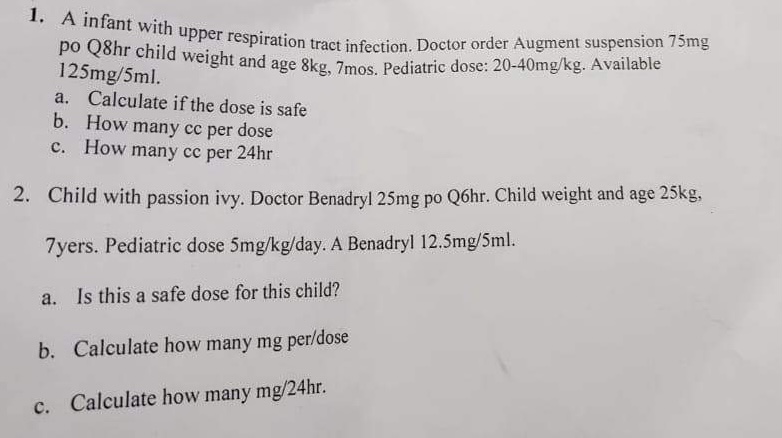
Upper Respiration tract infection

A infant with upper respiration tract infection. Doctor order Augment suspension 75�� po Q8hr child weight and age 8��,7mos. Pediatric dose: 20-40����. Available

125��5��.
a. Calculate if the dose is safe
b. How many cc per dose
c. How many cc per 2student submitted image, transcription available4ℎ�
Child with passion ivy. Doctor Benadryl 25�� po Q6hr. Child weight and age 25��,
7yers. Pediatric dose 5���� day. A Benadryl 12.5��5��.
a. Is this a safe dose for this child?
b. Calculate how many �� per/dose
c. Calculate how many ��24ℎ�.

Structure level of nursing knowledge

Name 15 nursing theorists with their corresponding theory and structural level. Classify each theory according
to its structure level of nursing knowledge: Philosophy, conceptual models, Theories/Grand theory, Middle
range theory. Example: Name: Florence Nightingale Theory: Environmental Theory Structure level: Philosophy

The NONPF Independent Practice Competency

Advanced physical assessment: How does Human virtual stimulate patient encounter help meet the goals of the competencies from the NONPF Independent Practice Competency: 1. Practices independently managing previously diagnosed and undiagnosed patients?

Describe how this helped accomplish the NONPF Independent Practice Competency: 1. Practices independently managing previously diagnosed and undiagnosed patients in detail?


Provide at least two specific examples.